My friend Mark Stang periodically contacts me with a baseball photo mystery. The search for answers to his questions is almost always fun and challenging, because Mark is a top-notch baseball researcher and he really knows his baseball pictures. His groundbreaking book Baseball By the Numbers (written with Linda Harkness) is the encyclopedia of baseball uniform numbers and is an indispensable tool for the baseball photo researcher. And his numerous books of baseball photographs should be on every baseball fan's bookshelf. You can find out more about Mark's wonderful books at his web site.
Mark is currently working on an illustrated history of the Braves and one of the latest mysteries he sent along has to do with the "Miracle" Boston Braves of 1914. (For another post about this club, check out my earlier blog entry titled "Rabbit Maranville is not a Nazi.") Mark emailed the following image that can be found at the Prints & Photographs Online Catalog at the Library of Congress …
Library of Congress, Prints & Photographs Division, LC-DIG-ggbain-17528
… accompanied by a note in which he stated that …
This [George Grantham] Bain photo of the 5 Braves players from 1914 has the ID's of Joe Connolly and Lefty Tyler reversed on the original neg. But Tyler is clearly the 4th from the left and Connolly 3rd …. Any idea what ballpark this is?As for the mix-up of identifications, Mark was absolutely correct. The noted positions of Joe Connolly and Lefty Tyler are swapped. Here's a detail from the mystery photo:

Here's an image of Lefty Tyler:

Library of Congress, Prints & Photographs Division, LC-DIG-ggbain-17334
And here is what Joe Connolly looks like:

Library of Congress, Prints & Photographs Division, detail from LC-DIG-ggbain-16903
The correct identifications of Mark's photo are (left to right): Hank Gowdy, Dick Rudolph, Joe Connolly, Lefty Tyler, Oscar Dugey. The "no name" in the bunch is Oscar Dugey, a journeyman infielder who spent parts of six seasons in the big leagues. His biggest claim to fame was that he played for two straight pennant winners: the 1914 Braves and 1915 Phillies.
The photograph that Mark sent along is similar to a number of others from the Bain Collection at the Library of Congress:

Library of Congress, Prints & Photographs Division, Detail from LC-DIG-ggbain-17527

Library of Congress, Prints & Photographs Division, Detail from LC-DIG-ggbain-17529
Clearly all three of these photographs were taken on the same day, at the same location, and essentially at the same time.
The uniforms of the Braves in the photograph are consistent with those worn by the club on the road from 1913 to 1915. Compare Hank Gowdy's uniform to the drawing found at the National Baseball Hall of Fame's online exhibit, Dressed to the Nines:

Each of the five players pictured played with the 1913 and 1914 Braves, but Oscar Dugey was traded to the Phillies in February of 1915, so we know the photo was taken in either 1913 or 1914.
And while we're looking at photos of Hank Gowdy, take a close look at his right hand as seen in the photo sent along by Mark as well as in each of the above photographs:

This comparison also suggests that the photographs were taken the same day, as the last two fingers on his right hand are taped together the same way in each picture.
As for Mark's original question, a review of grandstands of National League parks of the era fails to reveal a match to the various features seen in the background of any of the three similar photographs above. What about American League parks?
Take a look at the following photograph taken at Philadelphia's Shibe Park during the 1914 World Series:

Library of Congress, Prints & Photographs Division, detail from LC-DIG-ggbain-17540
Note how the pillars and roof line in this photo match well with those as seen in Mark's photo and the others taken that same day. Additionally, take a close look at this detail from the police photo:

The openings in the back of the grandstand are windows with shades that can be raised or lowered, depending on the angle of the sun. This also matches well with the openings seen in Mark's mystery photo.
(By the way, take a look at this other detail from the police photo:

Not only are there numerous fans perched atop the advertisements beyond the left field wall, but one fan has even clambered up the side of a telephone pole in an effort to catch a glimpse of World Series action. You have to applaud that guy's passion, though not necessarily his "good" sense.)
So we now have an answer to Mark's question: "Any idea what ballpark this is?" It's Shibe Park in Philadelphia. But can we learn anything more?
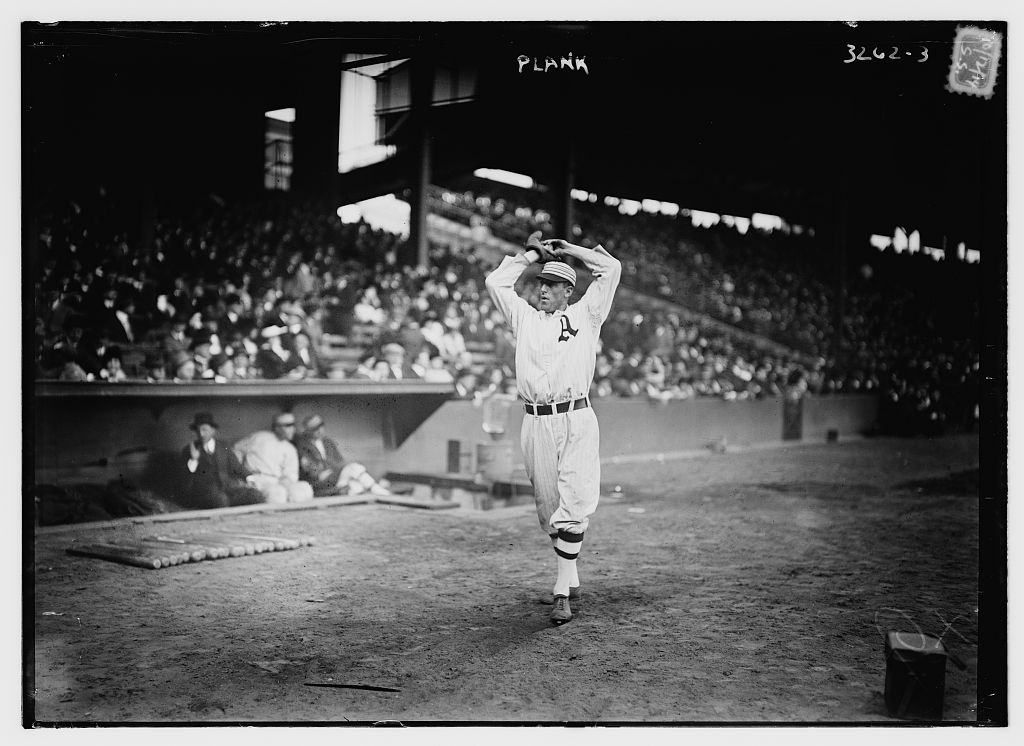
Take a look at yet another photograph from the Bain Collection at the Library of Congress:
Library of Congress, Prints & Photographs Division, Detail from LC-DIG-ggbain-17540
That's future Hall of Famer Eddie Plank warming up before his start in Game Two of the 1914 Series on October 10. Recognize the grandstand in the background with the distinctive windows and shades? Not only is it Shibe Park, but the levels of the various shades in the windows match those seen in Mark's photo exactly! Here's a comparison with Mark's photo aligned directly underneath the corresponding windows in the Plank photo. Take a careful look.

There's little doubt that the photos were taken on the same day: October 10, 1914. But just to make sure, let's take a look at some other evidence.
First, there is this note found in a column titled "National League Notes" in The Sporting Life of July 25, 1914: "Hank Gowdy, the Boston Braves' catcher, is out of the game with a broken finger, and [Bert] Whaling is doing most of the backstop duty." Though Mark's mystery photo was taken some two-and-a-half months later, it seems likely that Gowdy was taping his fingers together for added support for the recently broken digit.
Next, take a look at yet another photo from the Bain Collection:

Library of Congress, Prints & Photographs Division, Detail from LC-DIG-ggbain-17538
Here Braves catcher Hank Gowdy is seen shaking hands with John F. Fitzgerald, the former mayor of Boston (and future grandfather of John F. Kennedy) who was known as "Honey Fitz." What is such a dignitary doing at the ball game? Well, Fitzgerald was a prominent member of Boston's Royal Rooters, a fan club that generally cheered for the Red Sox. However, with Boston's other ball club in the series, the Rooters passionately pulled for the Braves in their 1914 clash with the Philadelphia Athletics. Fitzgerald's attendance at Game Two was noted in an article from The New York Tribune of October 11, 1914:
Tyler and James warmed up for the Braves, but Plank was the one an d only choice for Mack. Before anything could be started a fair lady with a bunch of red roses came over to the Boston bench and gave Hank Gowdy a traveling bag. Hank took the bag, but looked unhappy. Honey Fitz came out and took a rose. He looked happy and did not blush as Gowdy had done, even when the camera men snapped his picture.Notice the traveling bag on the ground at far left in the photo? And take a look at the "Royal Rooters" pin affixed to Fitzgerald's lapel. Note how it compares with an actual pin that was sold at auction in 2008:

And notice the press pass attached to the unidentified individual at far right. Here's a comparison of that pass and a Shibe Park press pass from the 1914 Series that was sold at auction in 2009:

And take a look at Gowdy's taped fingers as he shakes the former mayor's hands:

Clearly, the photo of Gowdy with Fitzgerald was taken at the same time and location as Mark's mystery photo.
Now let's take a look at one more piece of evidence. Notice that Fitzgerald is holding a newspaper in his left hand. Here's a closer look:

The paper is none other than The Philadelphia Ledger. A logical assumption is that the paper is a morning edition of the Ledger from the day of the game: October 10, 1914. The Library of Congress has digitized numerous newspapers and made them available to the public at their Chronicling America web site. Thankfully, they've digitized a number of issues of The Philadelphia Evening Ledger, a later edition of the same paper. Here's what the October 10 edition of that paper looked like:

Here's a detail of the baseball-oriented political cartoon on the front page:

Now compare the newspaper in Fitzgerald's hand to the same section of the evening edition:

While the morning and evening editions differ in some ways (e.g., the morning edition has a story at far right previewing Game Two of the Braves-Athletics matchup; the evening edition reports on the progress of the game), both editions feature the political cartoon at the top center of the front page. This is the final "nail in the coffin" proving that the Gowdy-Fitzgerald photo, as well as Mark's original mystery photo, were both taken at Shibe Park prior to Game Two of the 1914 World Series on October 10.