Showing posts with label Detroit. Show all posts

Tuesday, September 17, 2013

Buy Me Some Peanuts: Elephants Playing Baseball


Back in 2010, as part of his always-entertaining "There's No Service Like Wire Service" series, Paul Lukas of Uni-Watch posted a link to this photograph of elephants donning baseball gear:


I thought I'd research the photo to see what I could learn.

First, I focused on trying to determine the location of the image. Thankfully, the buildings in the background provided a number of clues.

Beyond the right-most elephant's rump we see the words "GOLDE" and the phrase "2 PANTS SUITS." Other signs nearby read "GOLDE CLOTHES." Using these key words, I found a promising lead in "The Catalogue of Copyright Entries for 1923" available at Google Books":


Apparently the Golde Clothes Shop had obtained a copyright on an illustrated sheet (a poster?) that promoted a special offering. This suggested that the building in the background was Golde Clothes Shop in New York, and that the photo was taken sometime around 1923.

Unfortunately, when I researched Golde Clothes Shop, I found that the retail clothier had over two dozen stores across the country in the 1920s. Maybe the photograph wasn't taken in New York City after all.

I next turned my sites toward the building in the background at center topped with the letters "HUDSO." It seemed likely that these were the first letters in the word "HUDSON." Was there a city street somewhere in the country that featured both a Gold Clothes Shop and an establishment with the word "HUDSON" in it's title? Indeed there was.

Take a look at this photograph found at the Library of Congress web site:


Library of Congress, Prints and Photographs Division, LC-D4-500950

The photo is titled "Looking up Woodward Avenue, Detroit, Mich." and is dated c. 1917. While the exact styles of the building advertisements do not match those seen in the elephants photo, the buildings themselves match quite well. The location is identical, but the two pictures were certainly taken in different years.

Here's a detail from the Library of Congress's photograph showing the word "Hudson's" painted atop the building at center and the signage for "Golde Clothes":


... and here's another detail showing the building at far left:


This was Detroit's 14-story tall Majestic Building, built in 1896 and located at the northwest corner of Woodward and Michigan. The following photo of the Majestic Building (at center) shows its proximity to Detroit's City Hall (at left):

 
Historic Detroit

The photo of elephants was taken just south of the Majestic Building, on the southwest corner of Woodward and Michigan, in front of City Hall. Here's a modern-day map of the area, with the pink marker marking denoting the spot where the elephants made their ball-playing appearance.


With the location of the shot determined, I turned my attention to the elephants.

Believe it or not, as early as the 1910s there were a number of different acts that featured ball playing pachyderms. Here's an image of elephants from the Gentry Brothers Circus doing their act in 1917:


Circus Historical Society

... and here's a 1913 promotional poster for Mooney's ball-playing elephants featured in the Barnum & Bailey Circus:


Robert Edwards Auction

It appears that the elephants in our Detroit-based photograph were Powers' Elephants (sometimes called Powers' Dancing Elephants), a popular act that played for many years at the Hippodrome in New York City, but by 1923 was traveling around the country.

On June 23, 1923, the Titusville (PA) Herald promoted the act as it was scheduled to appear at a local fair in mid-September:

The directors of the Titusville fair ... take pleasure in announcing the engagement of Power's [sic] Dancing Elephants for the entire four days of the fair with exhibitions afternoon and evening.
Those four mammoth, pachyderms have been entertaining hundreds of thousands of people annually from the stage of the famous Hippodrome in New York for the past eighteen years, but owing to the tearing down of the amusement place, the manager of these elephants has taken them on the road this season. The elephants do amazing tricks and their baseball game Is said to be the marvel in its line of animal training.
In the ball game everything is included, even one of the "pitchers" retiring from the box when ordered and the substitute allows the "batter" to make a home run, the elephant runner even "sliding" to the home plate.
And according to an article in the New York Evening Telegram of August 4, 1923,

At the Shadukiam Grotto Pageant, Detroit, the principal feature was the act of Powers' Elephants, under the management of Jimmy Dunedin, a well-known Keith Exchange booking agent. The engagement was by courtesy of E.F. Albee in answer to a request of the Mayor of Detroit, a friend of the Keith executive. The every appearance of the mastodons on the streets of Detroit drew crowds who watched the animals do stunts.
There is little doubt that this photo captured Powers' elephants doing one of their "stunts" in promoting their appearance in Detroit in August of 1923.

Monday, September 20, 2010

The Play at the Plate


In 1999, the Detroit News published Home Sweet Home: Memories of Tiger Stadium, a book containing some wonderful photos from the newspaper's archives. Check out this one of Detroit's Recreation Park on page 15 (more about that park here):


... and this nice action shot on page 19:


Another great photo is found on page 25:


Its caption reads:
Ty Cobb was safe at home in this close play at the plate, sliding deftly under the tag of Boston catcher Lou Criger in a game at Bennett Park.
It's a marvelous photo, but I've got a problem with the caption. I agree that the catcher is Lou Criger, a fairly distinctive looking fellow with light brown (or red?) hair, a thin build, and a somewhat gaunt face. Here are a few other photos of the longtime American League catcher:


Chicago Daily News negatives collection, SDN-001462. Courtesy of Chicago History Museum


Library of Congress, Prints and Photographs Division, [LOT 13163-17, no. 43]

There's really no question that the catcher is Criger, but he's certainly not wearing a Boston uniform. Take a good look at this detail:


There is clearly a patch on Criger's left shoulder. In fact, it's a Fleur-de-lis. The same marking adorns Criger's cap, which he tossed behind him and is seen on the ground just beyond the umpire's left leg. The decorative symbol has long been associated with the city of St. Louis and was used at various times on St. Louis Browns uniforms. Indeed, Criger's uniform and cap are consistent with the club's outfit of 1908 and 1909. Since Criger's only season with the club was 1909, we can be pretty certain that was the year the photo was shot.

So while the caption states that the photo is of Criger with Boston in 1904, it's actually of Criger with the Browns, five years later.

As for the location, it is most certainly Bennett Park in Detroit. Not only are the Tigers wearing their home whites, but the roof of the stands in the background matches that seen in this large panoramic photo from the Library of Congress:


Library of Congress, Prints and Photographs Division [LC-USZ62-123165 DLC]

Note also that the two light "patches" on the roof match those seen in the panoramic photo. Here's a detail from the above panoramic photo:


In 1909, the Browns played a dozen games against the Tigers in Detroit: April 30, May 1, June 22, June 23, June 24, June 25, June 26, September 5, a doubleheader on September 6, September 13 and September 14.

According to The Sporting Life of May 8, 1909, the April 30 game between Detroit and St. Louis was "played on a damp field in very cold weather." Not only does the field not look particularly damp, many of the fans have removed their jackets. This date is highly unlikely.

The next day's game can also be eliminated, as the same paper stated:
It was bitterly cold, a high wind blew and the umpires stopped the game in the fourth and again in the sixth because of blinding snowstorms that interrupted play.
The next series of games took place in June and these five dates are all much more likely.

The early September series is a possibility, though Criger did not play in the field during the first game of the doubleheader on September 6, so we can eliminate that game from the running.

Finally, the mid-September pair of contests are out, as Criger did not play in either game.

We are left with the following possible dates: June 22, June 23, June 24, June 25, June 26, September 5, and the second game between the Browns and Tigers played on September 6.

The photo is wonderful, not just because it captures a great bit of action at the plate, but it encapsulates the turbulent history between Criger and Cobb. According to The Sporting Life of March 27, 1909:
Catcher Criger, of the Browns, [was] quoted as saying that Ty Cobb is a bone-headed base-runner, and that he can outguess Tyrus.
Two months later, in the May 22 issue of The Sporting Life, Cobb was reported as saying:
I never knock a ball player. Yes, Criger is a good catcher, but I don't believe he's playing the game he put up last year. I'll say this much, though, that I think he and Cy Morgan tried to put me out of business last year over in Boston. You know Morgan throws a vicious ball. He aimed one at my head and if I hadn't fallen it would have killed me.
In the biography titled Ty Cobb, Charles Alexander summarized the Cobb-Criger rivalry of 1909:
Just as the Browns left Dallas (their spring training site) and the Tigers came in, the local newspapers quoted Criger as bragging that Cobb had never given him much trouble and that "I've got his 'goat,' and I've got the rest of that Tiger bunch, too." Criger went on to say that in past seasons, when Cobb got up after dodging close pitches called by Criger, "the fight was all out of him."

Before Criger could get out of Dallas, Cobb hunted him up to promise that he would steal on Criger the first time he got on base against the Browns that year. That he did, when the Browns came into Bennett Park on April 30. It would make a good story if Cobb had actually run wild on Criger everytime Detroit and St. Louis met for the rest of the season, as Cobb later claimed in his autobiography. Yet besides Cobb's confusion in chronology, so that he had Criger in 1909 still catching Cy Young for Boston, the fact is that Criger generally held his own against Cobb and the rest of the Tigers on the few occasions when he played against Detroit that year. Cobb never successively stole second, third, and home on Criger, as he maintained. On May 1 he did clearly show up the veteran catcher by taking second after hitting into a fielder's choice, as Criger held the ball at homeplate; and toward the end of the season he stole second and third in succession on Criger. But on June 24, Criger pegged him out twice in a row, and later that day Criger took Cobb's spikes on his unguarded shins to tag out the Georgian as he tried to score from third on a grounder to shortstop Bobby Wallace. Criger stamped the pain off, stuck a gauze pad on his wound, and stayed in.
I tried to track down microfilm of The Detroit News Tribune on inter-library loan, but unfortunately I struck out. So I contacted my good friend, Peter Morris, who lives in Michigan, in hopes that he might be able to do some quick sleuthing. It also doesn't hurt that Peter is simply unsurpassed when it comes to baseball research.

Indeed, Peter came through with flying colors, tracking down the photo in the Sunday, June 27, 1909 edition of The Detroit News Tribune. The photo, taken the previous day, was preceded by the following title:
COBB SPRINTED HARD TO MAKE FOUR BASES ON
HIS DRIVE, BUT THE BALL BEAT HIM TO THE PLATE
... and below the photo was a caption that read:
The Camera Shutter Snapped as the Georgian Slid to the Plate and the Veteran, Lou Criger, Tagged Him. The Ball Hit the Right Field Bleachers, But Bounded Back Into Hartzell's Hands, and a Quick Relay Resulted in the Georgian's Retirement at Home.
Umpiring behind the plate that day was Billy Evans, seen running in on the play at right.

The story of the game was a mistake by Criger (likely caused by Cobb's tactics) that cost the Browns the game. Here's the synopsis of the play as reported by The Washington Post on June 27:
Catcher Lou Criger made the champion bonehead play of major league history today, and through it lost a chance for an almost sure triple play and the cutting off of four Detroit runs. Incidentally, Detroit for a moment practically had four men on bases, paradoxical as the statement may seem. Crawford, Cobb, and Rossman had got on in order, with none out and O'Leary next up. He hit rather weakly to Jones, who pegged to Criger to force Crawford.

The play was so easy that Crawford only trotted in, expecting a sure out. But Cobb upset things. He commences to yell to Rossman and O'Leary to come on, and apparently got to Criger's goat, for Criger, without touching the plate, pegged back to Jones. Jones kept his head and shot the ball back to Criger, O'Leary being safe at first in the meantime.

Crawford stopped stockstill and nobody was out and four on, while Criger just stood and looked. Finally, Crawford made a dash for the plate and Criger touched him. On the original toss home, if he had stepped on the plate and thrown to third he surely would have got Cobb and probably Rossman too, and there would have been three out and no runs.
Still, Criger managed to retire Cobb on his attempt for an inside-the-park home run, as captured in this beautiful photo of the play at the plate of June 26, 1909.

Sunday, April 25, 2010

I Love a Parade


Well, Andy Strasberg has done it again. Last year he sent along a few photos from his Fantography web site that provided great fodder for baseball research. Now he's sent along another beauty that, I must say, has been incredibly fun to research. Check out this photo:


Andy had no information about the image at all. What you see is what you get. So what do we see?

First, a quick perusal of the picture reveals the following information:

  • some sort of parade is going on
  • a baseball float dominates the scene
  • given the size of the street and buildings, the location is likely a good-sized city
The float is adorned with autographs of numerous baseball players. Here are the names that can be discerned and the years they played in the big leagues:

  • Babe Dahlgren (1935-46)
  • Eddie Lake (1939-41, 1943-50)
  • Pee Wee Reese (1940-42, 1946-58)
  • Bob Feller (1936-41, 1945-56)
  • Dizzy Trout (1939-52, 1957)
  • Birdie Tebbets (1936-42, 1946-52)
  • Pat Mullin (1940-41, 1946-53)
All seven men played for different clubs, so apparently the float isn't meant to honor a specific team. And the years the players have in common are 1940, 1941 and 1946. Given the predominance of military uniforms worn by men and women both on the float and lining the streets, it's a good guess that the photo was taken either during or after World War II. This would point to 1946 as the most likely year, but at this point that's just an educated guess ... nothing more.

Not much more can be gleaned from the float. Some of the kids on top are wearing uniforms with words or letters across the chest, but nothing definitive can be discerned. And the words on the side of the float are extremely difficult to read, though I suspect the upper words read "JUNIOR BASEBALL."

Let's move to the street. An address, street sign, or business sign would be helpful, but very little jumps out. Indeed, I could find only three clues in this vein.

The first clue is the advertising on the side of the building behind the float. Here is a close-up:


We are seeing just the left half of the advertising on the wall, so it is a challenge to determine exactly what is written. At the top are the letters 'CUNNI." Below that is a circle with just a few letters visible: "DOW" and "D" and "ST." (I wonder if this might not read something like "DOWN THE D--- STREET?") Below the circle are the words "BUSH & LANE" displayed vertically and "PIA" and "AND" and further down "SAL" and "5" displayed horizontally.

Thanks goodness for the unobstructed vertical "BUSH & LANE." This was the name of a piano company, which means that the "CUNNI" is likely "CUNNINGHAM" (also a piano manufacturer) and the "PIA" is assuredly "PIANO." In short, the wall is probably an advertisement for a store that sells pianos. Alas, this information does no help determine a date, location or explanation for the photo.

A second clue is the presence of two strange towers, one at the right side of the photo and the other behind the float. Here's a close-up of one:


The image on each tower appears to be a movie reel floating above an automobile. Could this be a sign for movie parking? If so, why are there two signs? And why such an elaborate sign for such a mundane purpose.

The final clue is tough to see. It is hidden far down the street and sits atop a building on the left side. Here's a detail from the photo:


Above the roof of a building, a sign with three letters reads, from top to bottom, "FOX." It's not a unique word, but it is one that is often associated with theaters. Could this be a Fox Theater?

Following this hunch, the next move is to search for theaters named "Fox." As one might guess, there are quite a few. In fact, the folks at Cinema Treasures, a web site devoted to classic movie theaters, has cataloged nearly 200 theaters with the word "Fox" in their name, half of which were known simply as "Fox Theater." From the Fox in Spokane, Washington to the Fox in Hollywood, California to the Fox in Hackensack, New Jersey to the Fox in Pensacola, Florida: it seems that the four corners of the country and everyplace in between has had (or still has) a Fox Theater.

Continuing with the hunch and putting everything together, our Fox Theater was located in a decent-sized city during the 1940s. While that should help eliminate a number of theaters, it still lays before us a daunting task: which Fox is our Fox?

After hours of "Fox hunting," I managed to track down this image of the Fox Theater at 2211 Woodward Avenue in Detroit, Michigan.


Photo courtesy of http://www.scottymoore.net/detroit56.html

The vertical "FOX" sign on this building is slightly different than that seen on our mystery image, but the above photo was taken in recent times, not back in the 1940s. It is reasonable that the FOX sign may have changed a bit over the years, so I decided to dig a little further and found another image of the Fox Theater in Detroit:


Photo courtesy of http://commons.wikimedia.org/wiki/Category:Fox_Theatre_(Detroit,_Michigan)

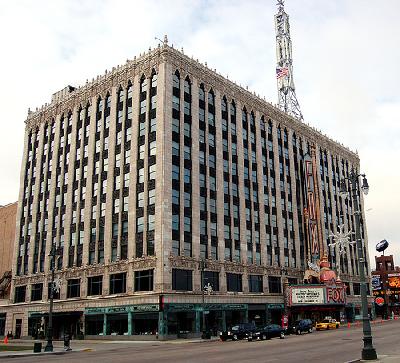
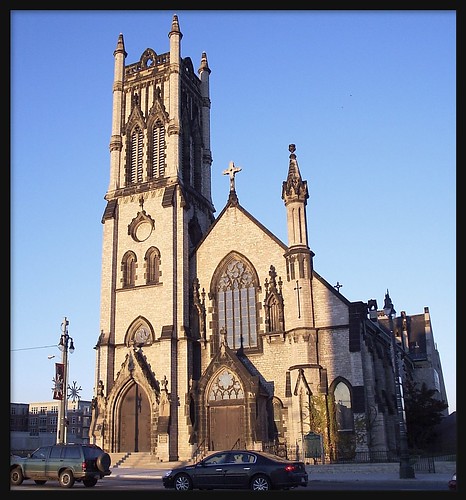
What is interesting about this modern photo of the theater is that across Woodward Avenue and down a block or so there is a church with a steeple. Referring to our baseball float photo, we see a similar church and steeple on the other side of the street from the building topped by the "FOX" sign. A quick look at a map of the area reveals that the church is the Central United Methodist Church at 23 East Adams (the corner of Woodward Avenue and Adams).

So both the Central United Methodist Church and the Fox Theater are still standing on Woodward Avenue. If only we could go to Detroit, walk down Woodward Avenue and see if any of the buildings we see match those in our mystery photo. Well, thanks to Google Street View, we can virtually take a walk down Woodward Avenue, so I did just that.

I started at the Fox Theater in Detroit and "walked" southeast on Woodward. Here's the view southeast with the Fox Theater on the right:


After "walking" few blocks southeast, I got to the Central United Methodist Church. Here's the view looking back (northwest) at the Fox Theater (on he left) from the church (on the right):


And, after "walking" a number of blocks further southeast, I turned around and looked back (northwest) at this scene:


We're just about half a block south of John R Street, looking northwest up Woodward Avenue, and voila! It's a perfect match with our baseball float photo. (Click here to enter Google Street View at the above location).

Revisiting the float photo, let's explore some of the distinctive buildings seen here on Woodward Avenue in Detroit.


A) Fox Theater, 2211 Woodward Avenue.

B) Central United Methodist Church, 23 East Adams Avenue (corner of Woodward and Adams)

C) Fyfe Building, 10 West Adams (corner of Woodward and Adams). Here's a great photo:


Photo courtesy of Detroit Publishing Company Photograph Collection, LC-D41-40

D) David Broderick Tower, 10 Witherell Street (corner of Woodward and Witherell). Here's a picture of the Broderick Tower (on the left):


Photo courtesy of http://brodericktower.com

E) Wright-Kay Building (also known as the Schwankovsky Temple of Music), 1500 Woodward Avenue. This is an absolutely gorgeous building and, apparently, the first in Detroit to have an electric elevator. Here is a photo:


Photo courtesy of http://detroit1701.org/Schwankovsky.htm

F) St. John’s Episcopal Church, 50 East Fisher Freeway. Hard to see in the baseball float photo as it is pretty far away. Here's a photo:


Photo courtesy of http://www.flickr.com/photos/71288712@N00/2383972369

So there's no doubt exactly where the photo was taken. But when was it taken? When was there a World War II-era parade on Woodward Avenue? Here's the answer:

Back in 1946, Detroit held the Automotive Golden Jubilee, a two-week celebration of the end of the war and war-time related manufacturing and a return to doing what Detroit did best: making cars. On June 1, 1946, the World's Fair-like celebration reached a climax with the Motor City Cavalcade, a parade down Woodward Avenue.

The Detroit Public Library has an excellent online exhibit about the Jubilee. The site features the following image of the cover of the Jubilee program:


Recognize the logo? It's the same "movie reel" floating above a car seen on the towers in the baseball float photo. But that's not a movie reel, it's a wheel orbited by electrons, a symbol of the automobile industry moving into the atomic age.

The following image of the parade is from Life magazine in 1946:


Note the numerous towers topped by the Jubilee logo, identical to those seen in our float photo. There's no question that our mystery photo was taken at this parade.

Amazingly, there is even footage of the parade on YouTube.

So, the baseball float photo was taken during the Motor City Cavalcade parade on June 1, 1946, from a location just about half a block south of John R Street, looking northwest up Woodward Avenue in Detroit.

But what of the baseball float? What is its story? Alas, I have been unable to find any information about that particular float. Perhaps one of my readers can help solve that final mystery.

Wednesday, October 21, 2009

Musings on Images of Detroit's Recreation Park


The University of Michigan has digitized many thousands of images at their "Early Detroit Images from the Burton Historical Collection" web site, including these wonderful photographs of Recreation Park in Detroit, the home of the Detroit Wolverines of the National League from 1881 to 1888.
(Clicking on an image below will open a new window and allow you to view larger versions).


The following image is a detail from the first photo, showing an intriguing poster:


Though it is difficult to decipher, some of the text on the poster reads as follows:
RECREATION PARK
?? 16 17 18 19
CAPT. PAUL
BOYTON
?? ENTERTAINMENT
2,342 MILES

Captain Paul Boyton was an adventurer who specialized in long-distance swimming with the aid of a special rubber suit and paddles. He would propel himself while on his back, something like a cross between kayaking and luging. In 1879, Boyton made his way from Oil City, Pennsylvania to the Gulf of Mexico in just 80 days, a distance of 2,342 miles. No doubt this latter number is the same as seen in the poster. This suggests that Boyton was making an appearance at Recreation Park sometime after his remarkable accomplishment, in mid-to-late 1879 or perhaps 1880.

These fantastic images of Recreation Park spurred my interest in looking for other photos of the ballpark, and in so doing I found that the last of the four photos above was the basis for this woodcut by Charles W. Sumner found in Silas Farmer's The History of Detroit and Michigan: or, the Metropolis Illustrated (1884):


The caption for the drawing reads "Recreation Park Entrance and Reception Building" and an accompanying paragraph describes the park as follows:

As a place for out-door entertainments, Recreation Park affords all facilities that can be desired. It is located on the Brush Farm, the entrance being a few blocks east of Woodward Avenue, on Brady Street. The grounds, embracing eighteen acres, are fitted up to accommodate exhibitions of various kinds. The Reception Building has every needful appliance for comfort and convenience. The Park was opened on May 10, 1879.
Since the book was published in 1884, this corroborates my guess that the photo was taken in 1879 or soon thereafter.

In tracking down still more images of the park, I stumbled on a bit of a mystery. The following photo of Recreation Park comes from page 81 of David Lee Poremba's Detroit: 1860-1899:


The note written near the top of the photograph reads:

BASE BALL GAME
PLAYED AT
RECREATION PARK DETROIT, MICH
ON
JUNE 19, 1886
BETWEEN DETROIT & CHICAGO
13 INNINGS WERE PLAYED ENDING IN A SCORE OF 1 TO 0
IN FAVOR OF THE HOME TEAM. RECREATION PARK
WAS LOCATED WHERE BRUSH ST. IS NOW BETWEEN
BRADY ST. AND ALEXANDERINE AVE. EAST

From the phrase "... where Brush St. is now between ...," we know that the note was not written contemporaneously. So how much do we trust this caption? Well, as it turns out, not much. A quick check of numerous sources reveals that Detroit and Chicago did not play a 13-inning, 1-0 game on that date. Is that date wrong? Or the score? Or the number of innings? Or some combination of any of the above?

At first, I thought the date had to be wrong, as I found the same photo (sans the notation) on page 53 of Picturesque Detroit and Environs, a book available at Google Books and purportedly published in 1883:


Since the publication date for the book was 1883, this would eliminate 1886 as a possible year. But after browsing through the book, I found that the author made mention of facts that took place after 1883. Indeed, various statistics for years up to and including 1892 are cited. It appears that the book was actually published in 1893, not 1883.

So I'm still left with the question: When was the photo taken? Alas, I don't have a definite answer, but my suspicion is that the date of June 19, 1886, is correct. The key is the enormous crowd, clearly evident in the photograph, and definitely on hand for the mid-June game.

That day, Detroit did indeed face Chicago in a much-anticipated game. The Wolverines had not lost a game at home all season: 18-straight victories at Recreation Park! As Chicago came to town, Detroit stood in first place with a record of 30 wins and just six losses (along with a tie game). Meanwhile, the Chicago White Stockings were in second place, just 2.5 games behind, with a 26-7 record (with one tie). A large contingent from the Windy City traveled to Detroit in anticipation of not just a single victory, but a series sweep, moving Chicago into first place. It was an audacious goal given the Wolverines unblemished record at home, but one that was embraced.

Fans of the White Stockings brought brooms with them to the park, each marked with the motto "Record Breakers," predicting the demise of Detroit's impressive victory skein. But Detroit fans had their own retort: a giant broom painted with the phrase "The Big Four and Five More." "The Big Four" was the nickname of the Wolverines' infield (Dan Brouthers, Jack Rowe, Hardy Richardson, and Deacon White), acquired in a controversial deal late in the season of 1885. "And Five More" referred, of course, to the rest of the starting nine.

The crowd was estimated at well over 10,000 and described as the most ever seen at the park. Coverage in The Washington Post of June 20 corroborates what we see in the photo:

The down-town ticket offices were thronged all the early part of the afternoon with people buying baseball tickets. The Woodward Avenue and Brush Street car lines tried in vain by putting on extra cars to accommodate the crowds going to see the first Chicago-Detroit ball game at Recreation Park. It was worse than any Fourth of July. The Chicago procession of carriages was noticeable for the brooms in the ship-socket of each. At 3 o'clock it was estimated that there were 10,000 people on the grounds. Rows of chairs were placed in front of the stand ten deep, and were all occupied by 3 o'clock. It was found necessary to stretch a rope about half way between the diamond at the back fence to keep the crowd back. This necessitated making special rules barring all home runs and three-base hits.
... as does this from The Chicago Tribune:

Ample accommodation had been made at the grounds to seat the immense crowd by placing 5,000 seats upon the lawn in front of the grand stand and open. Extending northward from both ends of the open and circling across the field was a line of spectators ten deep, and at 3:30 the diamond was literally enclosed by a living hedge of 13,000 people.
Chicago topped Detroit 5-4 (not 1-0) in nine innings, though Detroit came back to win the last two games of the series to remain in first.

Though I cannot say for certain that the photo is from this particular game, I think it highly likely.


Research Update: November 5, 2009

Baseball researcher Peter Morris made great progress on the handbill posted outside Recreation Park. He found that a note in the Detroit Free Press from June 15, 1879, confirmed that Boyton was scheduled to appear at Recreation Park from June 16 to 19.

I followed up on Peter's invaluable lead and found that starting in the June 13 issue of the Free Press there were a number of articles and advertisements about Boyton's visit. Apparently, his exhibitions were such a success that additional shows were scheduled for June 20 and 21. Here's the final advertisement from the June 21 issue of the Free Press:


Earlier ads heralded "CAPT. PAUL BOYTON, The World-famed Navigator, in his Rubber Life-saving Dress, in a New Original & Unique Entertainment. This is the first appearance in Michigan waters and his Nautical Exhibition, as given by him in all the leading cities in Europe and America, will be presented in its entirety. A splendid sheet of water, 7 feet in depth, adjacent to the Grand Stand, has been prepared especially for the occasion."

The article on June 15 stated that "Capt. Boyton has been engaged by the Recreation Park Company to give a series of exhibitions at the park next Monday, Tuesday, Wednesday and Thursday, at 5 o'clock each afternoon. A miniature lake seven feet in depth and 200x100 feet in area has been provided in full view of the grand stand and good music will be furnished during the exhibition."

This explains the water that is seen in front of the grand stand in the second of the four photographs above. Originally I thought this water was a feature of the park, but in light of the Free Press article it is clear that this "miniature lake" was created especially for Boyton's exhibition. Here's another look:


I think we can now state with certainty that the four photos of Recreation Park that were digitized at the University of Michigan were taken in mid-June of 1879.

I've tracked down a few other Boyton-related links, for those who wish to learn more about "The World-famed Navigator":