Showing posts with label New York Giants. Show all posts

Wednesday, November 15, 2017

Henry Sandham's Painting of the 1894 Temple Cup Series


On February 27, 1902, the New York Times ran a short article about the “first evening’s sale of the collection of water-colors and oil paintings from the New York shop of the French firm of Boussod, Valadon & Co., dealers in works of art, who have decided to discontinue their branch in this city.” Over the thee-day auction, 267 paintings sold for a total of $267,885. “La Ferte” by French artist Jean-Baptiste-Camille Corot sold for $11,500, while $9,500 took home a painting by Théodore Rousseau. Works by Jules Dupré, Alexandre-Georges-Henri Regnault, and Constant Troyon also sold for thousands of dollars. But, according to the article, “a truthful representation of the national game of baseball, by H. Sandham, was not much in demand, and was knocked down for $55.”


Photograph of Henry Sandham from The True Story of “Ramona,” Its Facts and Fictions, Inspirations and Purpose 

The whereabouts of the original 1894 painting by Henry “Hy” Sandham are unknown today, but in 1896 an engraving based on his work was published by Boussod, Valadon & Company, as noted in this article in the May 16, 1896, issue of Sporting Life:


One of these rare engravings can be found at the Library of Congress’s web site:


The illustration, sometimes known as “A Base Ball Match“ and other times “A Base Ball Game,” may be Sandham’s best-known work, but the prolific Canadian artist painted other wonderful works, as well. In particular, he created a series of sports-themed watercolors (bicycling, ice skating, tennis, and tobogganing) published by Louis Prang & Company in the mid-1880s, as well as another painting depicting baseball.


But back to Sandham’s 1894 baseball painting ...

Many historians believe the picture represents not simply a generic baseball scene, but a game of the 1894 Temple Cup series, a post-season best-of-seven championship series between the top two clubs in the National League: the second-place New York Giants and the pennant-winning Baltimore Orioles. But can this be substantiated?

Indeed it can.

THE BALLPARK

There’s no question that the park seen in the illustration is the famed Polo Grounds in New York. Compare it with this panoramic photograph taken after the turn of the century.


The photograph was taken from a very different angle than that drawn by Sandham, but the grandstand and left field bleachers clearly match. The park in the illustration is definitely the Polo Grounds.

THE TEAMS

Take a close look at the runner on third base. Across the chest of his jersey are the words “NEW YORK”:


Indeed, the player’s entire uniform is consistent with that worn by the Giants in 1894, as can be seen in this team photo from that season:


What about New York’s opponent? What club wore dark caps, dark jerseys, dark pants, and dark stockings with two lighter-colored stripes? As it turns out, during the 1894 Temple Cup series against the Giants, the Orioles wore specially-ordered uniforms that are remarkably similar to the above description. According to the October 3, 1894, issue of the Charlotte (NC) Observer:

The Orioles are to meet the Giants in the Temple cup series in new uniforms. The shirt and pants will be black. Across the breast of the shirt will be "Baltimore" or "Champions" in orange. A narrow orange strip will ornament the breeches down the side. Black and orange striped stockings and black Eton caps with either an oriole or monogram in orange just above the visor, and black sweaters will complete the outfit.
While the illustration fails to show any wording across the chest of the black jerseys or an orange decoration on the front of the cap, the other features of the uniform match perfectly. For example, in this detail from the illustration the Baltimore first baseman is shown wearing a black cap, jersey, and pants (featuring an “orange strip ... down the side”), and “black and orange striped stockings.”


The teams are assuredly the New York Giants and the Baltimore Orioles playing during the 1894 Temple Cup series.

THE SITUATION

The Giants swept the Orioles in four straight games during that first Temple Cup series, the first two games taking place at Baltimore’s Union Park and the next two at the Polo Grounds. Thus, Sandham’s painting:

  • depicts a particular moment from Game Three (October 6, 1894), or
  • depicts a particular moment from Game Four (October 8, 1894), or
  • depicts a fictional scene from one of those two games.

If we assume the action depicted is not fictional, what clues does the illustration present? There are many, but the following four stand out as most significant:

  • The Orioles pitcher throws right-handed and is about to deliver a pitch
  • The Giants have runners on first and third base
  • The Giants runner on first is breaking for second base
  • The member of the Giants awaiting the pitch bats right-handed
As it turns out, the handedness of the Orioles pitcher doesn’t help us, as the Orioles did not put a southpaw on the mound in either of the two games played at the Polo Grounds.

Careful examination of Game Three play-by-play reveals that at no time did the Giants have men on first and third at the same time. Thus, Sandham is not showing a particular moment from Game Three.

A similar review of play-by-play from Game Four offers just one promising possibility. According to the New York Sun of October 9, 1894, in the bottom of the seventh inning the Giants “got at [Orioles pitcher Kid] Gleason again. After [Shorty] Fuller had flied out, [Duke] Farrell singled and [Orioles center fielder Steve] Brodie made a fine catch of [Jouett] Meekin's long fly. [Eddie] Burke’s single put Farrell on third, and Eddie stole second himself.”

This description matches the situation in the painting perfectly. The Giants put men on first (Eddie Burke) and third (Duke Farrell), at which point Burke stole second. Alas, there is one problem: the Giants batter when Burke took off for second was Mike Tiernan, who batted left-handed, not right-handed as seen in the illustration. Here’s a baseball card showing Tiernan batting left-handed:


Perhaps Sandham intended to show this particular moment from the seventh inning of Game Four, but chose to use artistic license in placing Tiernan in the right-handed box, thus making for a better view showing the front of the batter? Or maybe it is simply a coincidence that the situation in the illustration is tantalizingly close to that seventh-inning scenario.

No matter what Sandham’s intentions may have been, there’s little question his artwork was meant to show the Giants and Orioles battling for the Temple Cup at the Polo Grounds in October of 1894. But the artist also intended to show something else: Himself!

Take a close look at the bearded gentleman in the front row of the grandstand just below and to the left of home plate:


Now compare this likeness with a reversed version of the photo of Henry Sandham I shared at the beginning of this post:


There is little doubt that the artist painted himself into the Polo Grounds crowd.

I am left with one lingering question. To the left of Sandham in the grandstand is an individual who is facing away from the action and staring straight at the viewer of the illustration:


Certainly this man is an actual person. But, I haven’t a clue just who this person is. Perhaps a reader of this blog can solve this final little mystery?

Sunday, March 17, 2013

"How the Office Boy Saw the Ball Game"


On August 16th, 1906, the New York Dramatic Mirror published the following short note:

The ball players of the New York and Pittsburgh teams of the National League, it is announced, will attend Thursday night's performance on the New York Theatre Roof, occupying the boxes. A new motion picture film, called “How the Office Boy Saw the Game,” will be shown.
As it turns out, the announcement was a bit late, as the event actually took place the previous Thursday, August 9th. Just hours after the Giants topped the Pirates 6-0 in the opening game of a four-game series at the Polo Grounds, the entourage of players made their way to the magnificent theater at Broadway and 45th Street:


Dorothy Parker Mysteries

There, as part of a special "Baseball Night," the Giants and Pirates saw a one-act musical entitled "Seeing New York," enjoyed the celebrated harmonies of Aubrey Pringle, Harry Sylvester, Poodles Jones, and Frank Morrell, better known as "THAT Quartet," and took in a number of other vaudeville skits before viewing the short film that starred members of both clubs.

The movie, fully titled "How the Office Boy Saw the Ball Game," likely had a running time of around 13 or 14 minutes. However, all that remains today is a hodge-podge amounting to some five minutes of footage. Thankfully, the little that has been preserved is readily available on the web at fandor.com, and on a two-DVD set of selected early baseball silent movies titled "Reel Baseball."

The film was directed by Edwin S. Porter, the early silent movie director who was responsible for the famed 1903 picture "The Great Train Robbery." As summarized by Charles Musser in his book "Before the Nickelodeon: Edwin S. Porter and the Edison Manufacturing Company," the plot of the baseball movie is as follows:

In a small office, the lady stenographer writes a note for the office boy that reads "Dear Teddy: Come home at once. Grandma is dead." The boss accepts the excuse and the office boy has a free afternoon to see the game. The young lady stenographer faints in disbelief when the boss falls for the explanation. The bookkeeper is told to escort her home. Left alone, the broker also decides to take the afternoon off and see the game. The remainder of the film intercuts Teddy on a telephone pole looking through a spyglass with masked point-of-view shots of the game—including a view of the boss discovering the stenographer and bookkeeper in the stands.
Let's take a look at the baseball scenes from the movie as they appear on the "Reel Baseball" DVD.

At 1 minute 21 seconds into the footage, we see an automobile driving on the field at a ballpark. Remember, that all the footage of the game is seen through the office boy's telescope, so these scenes are all cropped within a circle. What I wouldn't give for the original un-cropped footage!


Over the next 20 seconds or so, we see a number of automobiles on the field, each filled with ballplayers.


Note that the wall behind the cars is adorned with bunting, so it is likely that some special event occurred at the park that day. Indeed, the next shots show a band parading across the field ... another indication that something special was going on:


And marching right behind the band is a line of ballplayers:


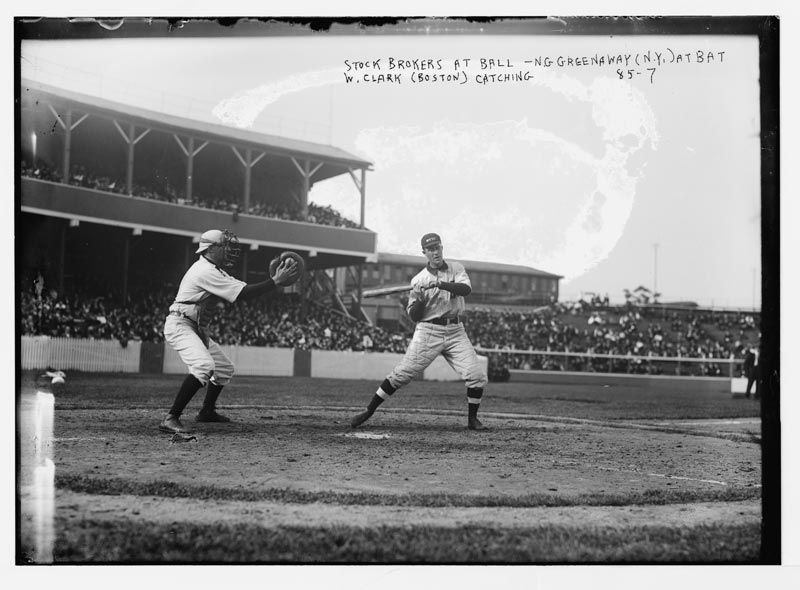
There's no question that the ballpark is the Polo Grounds in New York City. Comparing some known images of the famous park with some of these movie stills will corroborate this fact. For example, take a look  at this photograph of action from a New York vs. Boston Stock Exchange game played at the Polo Grounds on May 23, 1908:


Library of Congress, Prints & Photographs Division, LC-DIG-ggbain-00475

(For more about these series of stock exchange games, read my blog titled "When Wall Street Occupied the Ball Park.")

Now compare this image with the first movie still seen above. While the camera angles are not quite identical, one can readily see the similar beams (blue arrows) at the corner of the grandstand, as well as the matching building (green arrow) beyond the bleachers down the third base line:


And here's another photograph of the Polo Grounds, this one taken on July 17, 1908, at a fund-raising event for the New York Home for Destitute Crippled Children:


Library of Congress, Prints & Photographs Division, LC-DIG-ggbain-02008

Note that while the advertisements on the outfield walls differ (because the photographs were taken in different years), the distinctive building beyond the outfield walls matches perfectly:


Now look at a detail from the still of the parade of ballplayers:


Though a bit out of focus, we can see that the players are wearing white uniforms with dark caps, dark stockings and, most importantly, jerseys with two lines of text. This matches well with the audacious outfits worn by the Giants in 1906, in which the club proudly proclaimed their status as "World's Champions." Here is a photo of New York's Mike Donlin wearing the same uniform:


Library of Congress, Prints & Photographs Division, LC-USZ62-105851

(For more on Mike Donlin, check out my blog posting titled "A 'New' Role for Mike Donlin.")

With the knowledge that these scenes were shot at the Polo Grounds in 1906, I was able to track down the following series of images published in the New-York Daily Tribune of June 13, 1906:


Not only does the upper picture show the same parade of ball players (even the players who are wearing jackets match up quite nicely with our movie still), but the lower picture shows one of the player-filled automobiles, as well. The bunting on the wall also matches quite nicely with the stills. No doubt these pictures were taken at the very same event: the official raising of the Giants' world's championship pennant on June 12, 1906.

According to the Tribune article:

The stands were profusely decorated with bunting and flags. ... Shortly before 4 o'clock the members of both the New York and Cincinnati teams appeared on the field in automobiles and, after making several circuits, they went to the clubhouse where they formed in two files and, led by the Catholic Protectory Band, proceeded up the diamond, while the crowd cheered and shouted.
Indeed, a careful look at the uniforms of the other club parading in from outfield that day shows that their uniforms match well with those worn by the Cincinnati Reds that season.

As for the Catholic Protectory Band, they were widely heralded at the time as one of the leading bands in the United States and just the previous year had been chosen by President Teddy Roosevelt to lead his inaugural parade.


At 2 minutes 20 seconds into the footage, we see the lady stenographer and the bookkeeper in the stands as they are discovered by their boss.


In this scene, we see the stenographer holding a program in her hands. Here's a closer look of both the front and back of the program:


As one might guess, the program matches that used by the Giants in 1906:


Legendary Auctions

Here's a comparison:


At about 2 minutes and 40 seconds into the film, we see legendary Giants pitcher Christy Mathewson warming up on the mound:


A portion of this particular sequence is also available on YouTube.

Notice that just to the left of the "Hunter Rye" advertisement on the outfield wall, there is an unpainted fence. However, in a still from the June 12, 1906, pennant-raising event, that wall is not seen.


This suggests that the footage of Mathewson was taken on a different date in 1906 than that of the June 12 pennant-raising event. We'll be able to narrow down the dates for this Mathewson footage (as well as some other shots) when we examine some upcoming on-field scenes.

At about 3 minutes into the footage, with the Giants in the field, we see a base runner thrown out at first base.


Note that we once again see the unpainted fence to the left of the "Hunter Rye" advertisement. So, as with the Mathewson footage, this shot was also not taken on June 12.

The base runner's uniform appears to be most similar to the 1906 road outfit worn by the Pittsburgh Pirates, with their distinctive dark-colored collar on an otherwise gray jersey. The blue stockings with a single red stripe also match those worn by the Pirates that season.

So, just when did the Pirates visit the Polo Grounds in 1906? Well, their first trip to New York that year was for a four-game set against the Giants, June 18-21. However, rain postponed the first two of those contests. The club's next visit to New York was the August series in which they attended the movie. Therefore the footage featuring the Pirates had to have been shot on either June 20 or 21, just over a week after the pennant-raising event.

While it is difficult to state for sure, it seems likely that the Mathewson footage was taken on the same day that the play at first base occurred. But Mathewson's only appearance in the abbreviated series came on June 21st. In that game, starting pitcher Joe McGinnity was ejected in the fifth inning (following in the footsteps of his manager, John McGraw) and Mathewson was called upon to finish the contest. Is it possible that the footage of Mathewson was of him warming up in the fifth? Perhaps.

A dozen seconds later, the footage shows a rather strange play. The camera is set up such that the view is straight down the third base foul line, looking towards left field.


A base runner (a member of the Pirates) is on third base and the batter (is that Honus Wagner?) awaits the pitcher's delivery. As the pitch approaches, the base runner breaks for home as part of an apparent squeeze play.


While the exact origins of the squeeze play are not clear (there have been numerous stories as to when it first began and who invented it), it does appear that the play first became popular just one year earlier, as Clark Griffith and the New York Highlanders (later known as the Yankees) started to utilize the daring maneuver. This is almost certainly the first time the play had ever been captured on film.

The batter takes a short swinging bunt at the ball, but rather than running to first base, he quickly moves in the opposite direction, as if he is heading to the dugout.


Meanwhile, the base runner continues towards home, where there is a play at the plate. The runner appears to be out, but when the umpire walks into the frame, he makes no signal.


The two umpires who worked the June Pirates-Giants series were Bob Emslie and Hank O'Day. Though the final movie still above is somewhat unclear, the umpire looks much more like O'Day than Emslie. Here are images of O'Day (top) and Emslie (bottom) for comparison purposes:


SDN-005348, Chicago Daily News negatives collection, Chicago History Museum


The Conlon Collection

But for the squeeze play footage, why is O'Day seen without a mask or chest protector, as one would expect for the ump working the plate? And, come to think of it, why do we not see a third base coach (who we will see later on in the footage)?

Given the strange circumstances surrounding the play, it seems likely that the scene did not take place in an actual game, but was simply staged for the camera man.

However, at about 3 minutes and 30 seconds into the footage, we see a scene that appears to be "the real deal." A Pirates batter awaits a pitch, swings, connects, and heads to first.


Note that in this sequence a third base coach is visible in the background and the home plate umpire wears a mask and chest protector. The shot has all the hallmarks of an actual play from either the game of June 20 or June 21, 1906.

Also, by a careful study of the fans in the background, we can see that this at bat likely took place the same day as the staged squeeze play. While there are fewer fans in the stands for the squeeze play (perhaps it was staged well before the game began?) and the two scenes were shot from slightly different camera angles, certain patterns in the brightness of clothing colors (see blue ovals below) match well between the two shots. These crowd "finger prints" strongly suggest that the images were taken the same day.


Next, we see a few Giants batters take some hacks at the plate. The catcher appears to be a member of the Pirates, but with players warming up in the background, no umpire in sight, and the quick procession of multiple batters to the plate, it appears that we're once again looking at staged footage, not real game action. Still, it is interesting to see the players quickly parading to home for their swings. One of the batters is none other than Hall of Famer Roger Bresnahan:


Following this sequence, we once again see the lady stenographer and the bookkeeper in the stands, just before being discovered by their boss. Clearly this scene is out of order and should have preceded the earlier footage of the office workers at the game.


Finally, the last bit of footage is a shot of a faux scoreboard:


As one might guess, the scores are fictitious, though the Giants are shown to be playing against the Pirates, the opponents we see most often in the available footage from the movie.

Researching what is left of this movie shot over a century ago leaves the interested baseball historian both pleased and frustrated. With moving images from the 1906 season, the movie contains some of the earliest footage of major league baseball known to exist, yet one is left wondering what priceless shots have been lost to father time.