Monday, June 4, 2012

A Closer Look at Photos Used to Authenticate the $4.4 Million Babe Ruth Jersey


On May 25, 2012, the Hauls of Shame web site posted an article by Dave Grob, Senior Baseball Uniform Researcher at MEARS (Memorabilia Evaluation & Research Services), in which the the author explained how he went about authenticating a purported Babe Ruth 1920 New York Yankees road jersey. The jersey sold earlier in May for a record $4.4 million.

A significant part of the authentication process relied on comparing the jersey with known photographs of Ruth. Reproduced below are the three main photos featured in the article:

Photo #1:


Photo #2:


Photo #3:


Let's take a closer look at each of these photographs.

PHOTO #1

This photo depicts Ruth with Joe Jackson. Here's the description from the Hauls of Shame blog:

Babe Ruth and Joe Jackson. Photo has to be from 1920 as in 1919 Ruth was with the Red Sox. In 1921 Jackson was out of Major League Baseball.
Indeed, for these very reasons, the photo most assuredly dates from 1920. But can we determine just when in 1920 the photo was taken?

First, a quick look around the Web reveals that there are many versions of the photo available. This one comes from Getty Images:


Getty Images #97293261

... and is accompanied by the following caption:
UNITED STATES - CIRCA 2002: Shoeless Joe Jackson (r.) of the Chicago White Sox and the New York Yankees' Babe Ruth look at one of Babe's home run bats. (Photo by NY Daily News Archive via Getty Images)
Well, certainly the Getty-provided date of "c. 2002" is inaccurate. We've already established that the photo is from 1920. But this larger version of the photo makes it easier to confirm that Ruth is wearing a road Yankees uniform, while Jackson is wearing the White Sox' home duds. Below are the relevant drawings by Marc Okkonen as found at the Hall of Fame's "Dressed to the Nines" online exhibit.

Yankees 1920:


White Sox 1920:


Thus, the photo was taken in Chicago in 1920. That season, the White Sox hosted the Yankees for three different series at Comiskey Park:
Given the limited number of dates above, I was able to track down this very same photo in the June 17, 1920 issue of the Chicago Tribune. Here's the picture with its original caption:


Our research is complete: The photograph was taken at Comiskey Park on June 16, 1920, before the Yankees vs. White Sox game in which Ruth hit his 18th homer of the season.

PHOTO #2

According to the Grob article, this photo dates from "late season 1921 or early season 1922." But how accurate is this range of dates?

For starters, while not mentioned in the blog posting, the photo clearly shows Ruth with his first wife, Helen, and their daughter, Dorothy. It will be seen that these identifications are critical to dating the photo.

As with the previous image, I thought it would be helpful to track down a higher quality version of the photo. Once again, I managed to find one at Getty Images:


Getty Images #72726016

The Getty caption reads:
NEW YORK - 1921. Babe Ruth poses with wife Helen and baby Dorothy before a game in Yankee Stadiium [sic] in 1921. (Photo by Mark Rucker/Transcendental Graphics, Getty Images)
While the identifications are correct, there are other problems with this caption. Why would Ruth be wearing a road uniform (as evidenced by the words "NEW YORK" across his chest) when the photo was taken "before a game in Yankee Stadium?" And, perhaps more importantly, how could the photo have been taken in 1921, when it wasn't until September 22, 1922, that he and his wife Helen revealed to the public that they had a daughter?

The news that Ruth was a father was widely covered, this report being published in the Chicago Tribune of September 23, 1922:
BABE RUTH A DAD FOR 16 MONTHS
Wife Admits It; Child Bred in Incubator.

New York, Sept. 22. -- [Special.] -- For sixteen months the one and only "Bambino," George Herman Ruth, has been the father of a little Bambino, and her name is Dorothy.
This surprising fact became known tonight when Mrs. Ruth indignantly denied that she had adopted a baby, a rumor to this effect having been circulated when she was seen at the Polo grounds, accompanied by a nurse and baby.
"Adopted a baby!" Mrs. Ruth exclaimed. "I have not! It's my own baby!"
Why She Kept It Secret.
Asked why the birth of the baby had been kept a secret, she explained, "Because it has been sick ever since it was born."
At the time of its birth, the exact date and place of which Mrs. Ruth refused to divulge, the baby weighed only 2 1/2 pounds, she said. Since its birth it has been "with a nurse," she explained, but would not say where the nurse had been.
According to clerks at the hotel where the Ruths live, the baby has been with Mrs. Ruth and the "Babe" in the hotel for only about a month. Mrs. Ruth has been taking it out in a baby carriage about 4 o'clock in the afternoon recently, a clerk said.
The clerk added a description of "Babe" Ruth with the infant when he was in New York. The big "Babe" comes downstairs about 7 o'clock each evening carrying the tiny bundle of humanity on one of his shoulders.
Happy, Hearty, and Fat.
Asked for a description of the baby, since Mrs. Ruth denied all reporters and photographers a glimpse of it, the clerk described it as "happy, healthy, and fat." He added it didn't resemble one of its parents more than the other.
Mrs. Ruth declared the infant was still quite small and thin, explaining that it had been bred in an incubator. She admitted it had been born prematurely. She was reluctant to talk of the child or discuss the details surrounding its birth.
She explained she did not want "to worry the 'Babe' while he was in Cleveland by reports of the baby's illness."
The mystery behind the 16-month-old Dorothy was never fully resolved. Was she Helen's biological daughter? Was she adopted? Was she Ruth's daughter by another woman? All of these possibilities have been forwarded by reporters and historians over the years. But for our purposes, Dorothy's background is of little consequence. The key is that Ruth and Helen did not make the existence of their daughter public until late September of 1922, so both the Getty and Hauls of Shame dates are off base.

So when was the photo taken? Let's start with the assumption that the Ruth family portrait was indeed captured in 1922, soon after the revelation that Ruth was a father. If so, it must be from the very end of the season. The Yankees played three series on the road following the revelation that Ruth was a daddy:
  • September 22-24 at Cleveland
  • September 28-30 at Boston
  • October 1 at Washington
After some digging, I was able to track down a September 30, 1922, issue of the Sandusky (Ohio) Register that featured the following photo:


Dorothy's outfit (love that bonnet!) and Helen's fur hat and clothing match well with those seen in the photo in Dave Grob's article. Certainly these pictures were taken at the same occasion. We can thus narrow the possible dates to a time period between September 22 (when the baby was revealed) to September 30 (in the very off-chance that the photo was taken the same day that the Sandusky Register went to press).

This latest date range implies that the photo was taken during the Yankees visit to Cleveland or to Boston. We know from the Chicago Tribune article that on September 22 Helen was in New York, not in Cleveland with Ruth. But did she later travel to Cleveland or Boston?

A clue comes from yet another image of Ruth with his baby daughter, this one found at the Corbis Images web site:


Corbis Image #BE045320

According to the Corbis web site, the photograph was taken on September 26, 1922, though the original caption was dated September 27, 1922 and read:
Boston, MA: Photo shows Babe Ruth playing with his baby Dorothy Helen Ruth at Fenway Park in Boston. He is here limbering up with his Yankee cohorts for the series with the Red Sox, which will determine the pennant race. Mrs. Ruth and the baby journeyed to Boston to spend a few days with the slugger.
Almost certainly this photo was taken at Fenway Park on the same day as the rest of the family portraits. The caption implies that the photo was shot on a date before the opening of the Yankees series in Boston, likely September 26, 1922.

PHOTO #3

This final photograph is a posed shot of Ruth in his batting stance. Dave Grob's article dates the photo to 1920, but is not more specific. Can we narrow down the time frame?

A quick search on the web shows that the picture is a cropped version of the following image:


The wall in the background certainly doesn't look like any found at a major league park of the era, so a reasonable initial guess is that the photo is from spring training. Following this lead, it didn't take long to find the same image in the Syracuse Post-Standard of March 28, 1920:


Thus the photo was taken no later than March 28, likely the 27th or earlier. And while we do not have an exact date for the photo, we have at least confirmed that spring training of 1920 is the correct time frame.

The entire 39-page analysis conducted by Dave Grob contains numerous other photographs, but I'll let other researchers have a crack at those images.

Sunday, May 20, 2012

There Used to Be a Ballpark Right Here - Ewing Field


With apologies to the folks responsible for the current Dos Equis advertising campaign: I don't always research minor league baseball, but when I do, I prefer the Pacific Coast League. (See my earlier posting titled The Stuff That Dreams Are Made Of, featuring an appearance by the PCL San Francisco Seals and Hollywood Stars).

In this second installment of my "There Used to Be a Ballpark Right Here" series, I'm taking a look at a San Francisco ballpark that was built nearly a century ago.

Every season from 1907 to 1930, the PCL San Francisco Seals played their home games at Recreation Park, located at 15th and Valencia. Every season, that is, except for one: 1914. That year, the Seals played at Ewing Field, a brand new park built by (and named after) club owner James Calvin Ewing.

Built for some $90,000 just eight years after the great San Francisco earthquake and conflagration of 1906, Ewing Field was billed as the city's first fire-proof ballpark. But it was fog, not fire, that doomed the park in 1914. Though the Seals finished the long PCL season with a record of 115 wins and 96 losses (their .545 winning percentage was third-best in the league), the constant presence of fog ultimately forced the club to abandon Ewing Field and hightail it back to Recreation Park. Thus ended the one-year "career" of Ewing Field as home of the Seals.

The park wasn't completely abandoned, however. For years, the site hosted numerous baseball and football games, as well as other special events. For example, back in late March of 1922, a two-day circus and athletic demonstration was staged at the park to benefit the San Francisco Community Service League. A number of wonderful photos of that particular event can be found at the Online Archive of California.

Here's one showing some sailors from the U.S. Navy sitting atop giant medicine balls, with the Ewing Field grandstand in the background:


Courtesy of UC Berkeley, Bancroft Library

And who could forget the "royal feminine loveliness" (the San Francisco Chronicle's words, not mine) of Agnes Margaret Pape, the Queen of the Community Service Circus?


Courtesy of UC Berkeley, Bancroft Library

But back when Ewing Field first opened, May 16, 1914, optimism for the new park was running high. Nearly all of the park's 18,000 seats were filled as local photographer W. Wesley Swadley captured a scene of Opening Day at Ewing Field in a gorgeous panoramic image available at the Library of Congress website:


Library of Congress, Prints & Photographs Division, LC-USZ62-126031

Located at what is now the southwest corner of Anza and Masonic, the ballpark sat some a half dozen blocks north of Golden Gate Park's panhandle. Today, all that is left of the park is its name, as the looping Ewing Road lies atop what used to be the ballpark's infield.

Taking a closer look at the panoramic image above, just two features can be seen outside the park: the cupola of a building and a water tower, both looming just beyond the left field wall. Here is a detail from Swadley's photo:


And here's an even closer look, zooming in on the cupola:


(By the way, check out the young men operating the scoreboard. One is resting against a box that contains various number placards, waiting to be posted on the board.)

While the water tower looks somewhat generic, the cupola appears quite distinctive. A different view showing the cupola is found in a detail from another photo at the Online Archive of California. As in the panoramic image, we are essentially looking south from the ballpark toward the building with the cupola:


Courtesy of UC Berkeley, Bancroft Library

But atop what building did this cupola rest? After some digging, I found the answer in an article about the ballpark's ultimate demise. The story was covered in numerous papers. This article is from the Nevada State Journal of Sunday, June 6, 1926:

BLAZES BREAK IN SCATTERED AREAS OF CITY

Flames Destroy Ewing Field, 12 Residences, Jumps Five Blocks


TWO FIREMEN HURT IN FIGHTING DEMON


Worst Fire Since 1906 Levels Gomes, Factories; Destroys Hemp


SAN FRANCISCO, June 5.—(AP)—Fire, believed to have been caused by a lighted match being dropped in the wooden grandstand at Ewing Field in the Richmond district, today started a conflagration which terrorized a neighborhood, destroyed many homes, did property damage estimated at $207,500, defied the entire fire department and forced volunteers into service when a $100,000 fire in the Mission district started at the same time.

Carried by a stiff trade wind over Calvary cemetery down to Broderick street, a distance of five blocks, embers from the Ewing Field blazes furnished thousands of torches that fell on wooden roofs and started numerous small blazes.

A number of wooden homes surrounding the field went up like so much tinder and householders, caught unnwares by the quick spread of the blaze, escaped without hats or coats in most instances.

The water mains in the vicinity of the Ewing Field fire were unable to furnish sufficient water to meet the demands of the firefighters and the auxiliary salt water system, built for fires of major proportion in the downtown urea, was out of reach.

Banners of smoke from the blazing field were visible throughout the city and attracted throngs of
spectators. Directly above the fire zone rose Lone Mountain with its cross, and thousands of men and women watched the fire from its sides and summit.

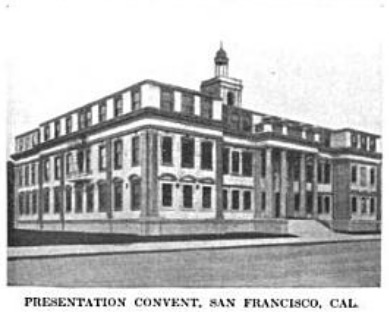
The nuns at Presentation Convent, operated by the Sisters of the Presentation, at Masonic Avenue and Turk street, only half a block removed from Ewing Field, prevented a panic by their cool-headed work. When it appeared that the convent structure was doomed, the nuns collected their movable valuables and were prepared to depart at an instant's notice.
Exactly what part of "fire-proof" did Ewing Field not understand?

Could the cupola belong to the Presentation Convent at Masonic and Turk? More digging produced the following image of the convent as found on page 427 of "The Catholic church in the United States of America - Volume II" published in 1914:


The cupola on the convent matches that seen outside Ewing Field quite well.

Though the convent was threatened by the Ewing Field fire, it was apparently spared, as the same building (sans cupola) still stands today at the northwest corner of Masonic and Turk. Here's an aerial image taken from the east from Google Maps:


And here's the view from the north, showing the side that faced the ballpark.


Another view of the one-time convent, this time from the ground and also looking from the north, is available in Google Street View:


The convent building, renovated by Oculus Architects, Inc. at the cost of $3,5 million, is now owned by the University of San Francisco. Meanwhile, the Sisters of the Presentation are today headquartered at 2340 Turk, just one building west of their old convent.

The moral of this story? Well, back in 1914, if you were a member of the Sisters of the Presentation and were crazy for Seals baseball, you could simply climb to the top of the convent cupola and peak out for a free view into Ewing Field.

From a baseball standpoint, I suppose this would make you nun the wiser.

Thursday, April 12, 2012

A Benefit Game for Survivors of the Titanic


The Titanic, George M. Cohan, a celebrated murder, The Great Gatsby … and baseball, all come together in a pair of photographs available at the Library of Congress' Prints & Photographs Online Catalog. Here are the photos:


Library of Congress, Prints & Photographs Division, LC-DIG-ggbain-11218


Library of Congress, Prints & Photographs Division, LC-DIG-ggbain-11218

And here's the story:

Less than a week after the Titanic sank to the bottom of the Atlantic Ocean, a brief notice was similarly buried … at the bottom of sports page of the April 20, 1912 issue of The New York Times. It read:
Ball Game for Titanic Survivors

President Frank Farrell of the Yankees and President John T. Brush of the Giants have consented to have their teams play an exhibition game at the Polo Grounds to-morrow afternoon at 3 o'clock for the benefit of the destitute survivors of the Titanic.
The contest of April 21, 1912, the first Sunday game ever played at the Polo Grounds, attracted over 14,000 fans, an impressive total on such short notice. And while the ball game was a laugher (the Giants trounced a depleted Yankees squad, 11-2), the event was a serious effort to raise money for the hundreds who managed to escape with their lives. Various newspapers reported that the receipts from the game totaled a tidy sum of $9,425.25.

Making an appearance for the Giants that day was one Phifer Fullenwider, what Keith Olbermann says is "the greatest name in baseball history." More on Fullenwider (seen in another Library of Congress photograph below) can be found in Keith's blog written back in December of 2009.


Library of Congress, Prints & Photographs Division, LC-DIG-ggbain-10326

And, for those true baseball history aficionados, even Charles "Victory" Faust had a cameo role in the day's events. (For more on Faust, check out this brief biography or his amazing full-length story, both written by baseball researcher Gabe Schechter).

But our story began days before the game, when entertainer George M. Cohan contacted William Randolph Hearst with an idea. If Hearst would publish a special Sunday edition of his New York American newspaper, Cohan would pay $5,000 for the first copy. Additionally, the 33-year-old composer/singer/dancer (what couldn't Cohan do?) would personally pound the pavement in New York City, selling copies of the paper to benefit the Titanic survivors.

According to the New York Tribune, Cohan "covered the city from the Battery to The Bronx [and] netted a sum that will amount to nearly $20,000." In the afternoon of his Sunday paper route, Cohan stopped by the Polo Grounds for the special Yankees-Giants ballgame and it was there that he was captured in the pair of photos.

Scrawled into the emulsion of both photographs is the name "Geo. Cohan" and the event: "'Titanic' Benefit Game." But the young man seen trailing behind Cohan in the pair of images has not been identified … until now.

Who was this fellow? Well, according to the same Tribune article, "throughout his trip [Cohan] was assisted by Jack Sullivan, founder of the Newsboys' Home." Though images of Sullivan are few and far between, they match well with the "other" man seen in these photographs.

Jacob A. Reich, better known as Jack Sullivan, may have been nothing but an unidentified shadow behind Cohan that April day, but just three months after the Titanic disaster, the man who was called "King of the Newsboys" was in the limelight, playing a significant role in the murder of New York gambler Herman Rosenthal. The details of the brutal shooting are beyond the scope of this blog (you can learn more about it in David Pietrusza's book Rothstein: The Life, Times, and Murder of the Criminal Genius Who Fixed the 1919 World Series), but the case was quite a sensation. It even made an appearance in F. Scott Fitzgerald's The Great Gatsby:
"The old Metropole," brooded Mr. Wolfshiem gloomily. "Filled with faces dead and gone. Filled with friends gone now forever. I can't forget so long as I live the night they shot Rosy Rosenthal there. It was six of us at the table and Rosy had eat and drunk a lot all evening. When it was almost morning the waiter came up to him with a funny look and says somebody wants to speak to him outside. 'All right' says Rosy and begins to get up and I pulled him down in his chair.

" 'Let the bastards come in here if they want you, Rosy, but don't you, so help me, move outside this room.'

"It was four o'clock in the morning then and if we'd of raised the blinds we'd of seen daylight."

"Did he go?" I asked innocently.

"Sure he went,"—Mr. Wolfshiem's nose flashed at me indignantly
"He turned around in the door and says, 'Don't let that waiter take away my coffee!' Then he went out on the sidewalk and they shot him three times in his full belly and drove away."

"Four of them were electrocuted," I said, remembering.

"Five with Becker." His nostrils turned to me in an interested way. "I understand you're looking for a business gonnegtion."

The juxtaposition of these two remarks was startling. Gatsby answered for me.
Ultimately, Charles Becker, a New York City Police lieutenant, was found guilty of the murder and, in the summer of the 1915, was sent to the electric chair at Sing Sing prison. Though Reich was released in 1913 on his own recognizance, he remained under indictment as an accomplice to the murder for over 20 years. The charges were not dropped until August of 1936, some two years before Reich passed away.

Funny how these various stories and characters all come together in a couple of pictures of a pair of "newsboys" at a ballgame. I suppose it's just another example of how a picture is indeed worth a thousand words.